
Butterfly Moments
Watch or read Butterfly Moments: Co-Regulation in Real Life’s transcript below!
Butterfly Moments: Co-Regulation in Real Life
When we think of regulation, we often envision calming someone else down when
they’re upset. Co-regulation, however, is about calming both of us together. But today,
we’ll explore a different perspective: co-regulation as a way to shift energy and foster
connection. Rather than just calming everyone down, it may involve being more active
for a while before everyone can settle. But we need to be active in ways that make
sense of the bigger picture and support the connection in the relationship.
Children’s needs must be met in their energy, rather than expecting them to adjust to
ours. This approach counters much of what we’ve been taught about parenting and how
we were raised.
Butterfly Moments are about joining our children in the state they’re in. Imagine
watching a butterfly flutter together; you’re not trying to control its movements. This act
of joining is co-regulation and creates a shared experience. I’ll share a couple of ways you can regulate yourself, and we’ll explore how this translates into a butterfly moment with your child.
Here’s an exercise to help you self-regulate before engaging with your child. By doing
this, you won’t rely on your child to regulate you; instead, you’ll model positive coping
strategies. It’s essential for our children to see that we have tools to help ourselves, so
that they can see it’s possible for them to learn. Their tools may be different from ours
and that’s ok. When you pause and come out on the other side more regulated, you
demonstrate effective self-care.
Eye Regulation Exercise for You as the Adult:
(Inspired by Linda Thai and Somatic Embodiment)
This exercise is about shifting out of survival mode. When we’re in a rigid, stuck pattern,
we need to find ways to shift out of it. If you are in a dangerous situation, our eyes need
to fix straight ahead at the threat, which works well if it is a leopard, but not so great if it is your child!
1. Find a Safe Space: As an adult, find a comfortable spot. If possible, close your eyes.
Always listen to your body and stop when you need to stop.
2. Shift Your Gaze: Move your eyes to the right (around 3 or 4 o’clock).
3. Affirm Safety: As you look to the right, say to yourself, “It’s safe enough for me to
look to the right.” Take a breath.
4. Return to Center: Come back to center and integrate that movement. Breathe.
5. Look Left: Now, look to the left (around 8 or 9 o’clock). This may be more difficult for some. Affirm, “It’s safe enough for me to look to the left.” Take a breath.
6. Awareness Behind Your Eyes: Bring your awareness behind your eyes without
twisting your head or your eyes. Say, “It’s safe enough for me to bring my awareness
behind my eyes.” Breathe.
7. Awareness Behind Your Head: Now, bring your awareness behind your head.
Breathe, affirming, “It’s safe enough for me to bring my awareness behind my head.”
8. Return to Front: Bring your eyes back to the front and breathe.
9. Check In: Notice how your body feels now. This is regulation—your body moving
toward a state of homeostasis, down-regulating and finding balance.
—
Engaging Our Children in Active Co-Regulation
Our children often need something more active than passive calming techniques. It’s
important to practice co-regulation exercises when we’re not upset, rather than waiting
until tensions rise. I recommend setting aside a couple of times each day to do this eye
exercise. You can explain to your child, “I’m doing this exercise because it helps me feel
better.” This doesn’t have to be the only exercise; any strategy that promotes well-being is valuable. But share what you’re doing with your child. Say it out loud.
Next, I want to show you how to translate this exercise into an interactive activity with
your child. This is not about forcing them to do something, especially with neurodiverse
children, as that approach often fails. Instead, we need to explore alternative strategies.
Using the principles we just practiced, we want to help our children move their eyes
away from a fixed gaze ahead. When children are focused on a screen, their eyes are
often locked straight ahead, which can trigger a survival mode response. We can use
supporting them to shift their gaze as a way to transition them away from the screen. If
you do an exercise just helping them to move their fun, they probably will only do it once
unless you find a way to more actively engage them.
I love the idea of pretending to follow a butterfly with our eyes together. This is a great
activity to do when you’re both calm—perhaps as a transition off the screen—but it’s
best to practice it at other times first. Talk to your child about how looking straight ahead
can put their brain into survival mode, making them more likely to feel fight-or-flight
impulses. Explain that we want to release some of that pent-up energy!
Consider going for a walk while keeping eye movement in mind. Encourage your child
to look down at the ground for flowers or up at the sky for birds. By moving their eyes,
we help them exit survival mode and begin to see other options and possibilities.
The goal is to help them move their eyes in a way that fosters connection. It’s not about
forcing them to look to the right or left; rather, it’s about exploring together, as if you’re
both watching a butterfly. Even if you’re just pretending to see a butterfly, you can
encourage your child to lead and you can follow where they’re looking.
You can say, “Where do you think the butterfly will go next? I’ll follow where your eyes go so we can watch it together.” This is co-regulation in action. At the end of the activity, make eye contact and take a breath together. You’ve just co-regulated!
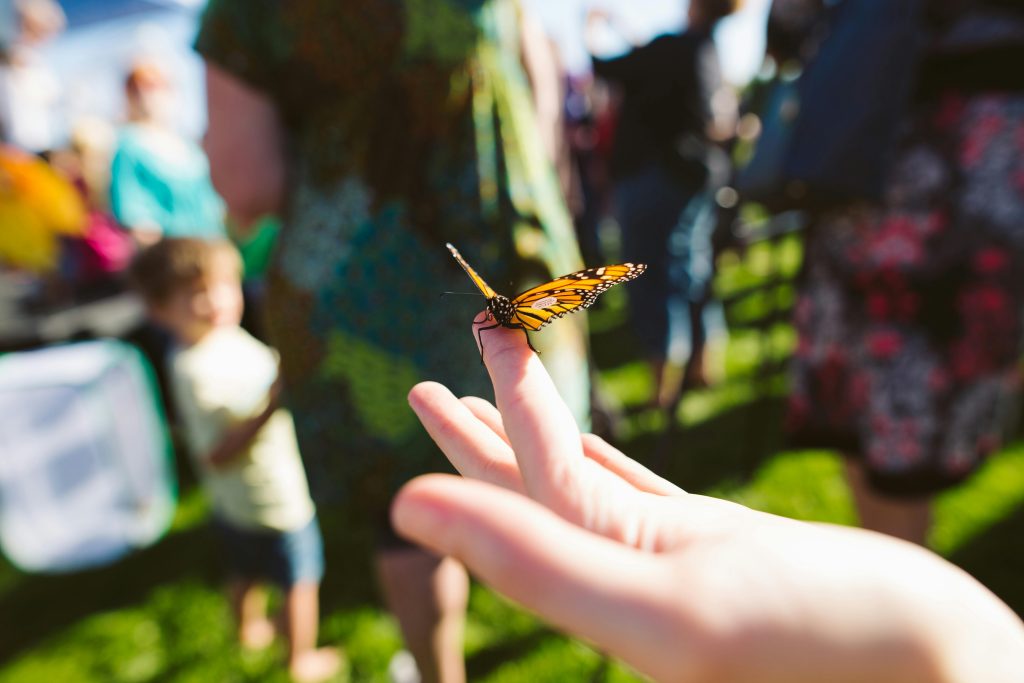
For younger children, consider using a prop like a stuffed animal or a toy butterfly. Let
them direct the butterfly’s movement as you both follow it with your eyes. If your child
needs more movement, go for a walk, have little races, or jump on a trampoline while
pointing out birds in the sky. Engage in playful activities together, giggling and slowing
down together as you connect.
I’d love to hear your stories! What strategies have worked for you and your child? What
have you already tried that was helpful? I’ll be sharing some of those stories so others
can find their own way with their butterfly moments. Remember, there’s no right or
wrong approach here—just focus on what you can do to connect.
And always remember: at no point should you force your child to participate. If your
child isn’t interested, focus on your own self-regulation. Model this behavior for your
children, especially older ones who may not want to join in. They will learn from your
example, especially when you return feeling more resourced and better able to connect
with them.
Want a homeschooling craft for younger children (and also maybe for yourself)?
You can find printables below with outlines of different butterflies. You can make your own butterflies and take turns flying them around. Take turns leading and following but
mostly join your child for these activities.
Butterfly Template below
https://onelittleproject.com/butterfly-template/
